


All Products
-
Structural Steel Fabrication
-
Heavy Steel Fabrication
-
Metal Steel Fabrication
-
Sheet Metal Fabrications
-
High Rise Steel Building Construction
-
Structural Steel Frame Construction
-
Steel Girder Bridge
-
Steel Truss Bridge
-
Pedestrian Overpass Bridge
-
Prefab Steel Frame
-
Light Steel Framing
-
Galvanized Steel Structure
-
Stainless Steel Fabrication
-
Steel Street Light Pole
-
Overhead Sign Structures
-
Steel Arch Bridges
-
Precast Girder Bridge
-
 Donald McwayneGood team members always offer budget in time and answer questions with patience, great job!
-
 Joseph AlexanderI am feeling fully respected when taking with Grace and she always gave the best advice. The first batch of the bridge panels got are great too. thanks all.
Octagonal Tapered Steel Monopole Tower - Hot Dip Galvanized Flange Bolted Monopole for 5G Telecom Antenna



| Place of Origin | China |
|---|---|
| Brand Name | FASEC |
| Certification | ISO 9001; ASTM A123 / EN ISO 1461; AWS D1.1; SGS/BV/TUV Inspection |
| Model Number | Steel Monopole |
| Minimum Order Quantity | 100 MT |
| Price | USD 1,000-1,500/MT |
| Packaging Details | Sea Freight (Container/Bulk Vessel) |
| Delivery Time | 30-60 Days |
| Payment Terms | L/C, D/A, D/P, T/T |
| Supply Ability | 5,000-15,000 MT/Year |
Product Details
| Structure Type | Self-supporting Single Tubular Pole | Surface Treatment | Hot-Dip Galvanizing 65μm – 100μm+ (EN ISO 1461 / ASTM A123) |
|---|---|---|---|
| Internal Structure | Stiffener Diaphragms, Pre-formed Cable Entry Holes | Accessories | Platforms, Ladders, Cable Trays, Antenna Brackets, Aviation Light, Earthing Terminals |
| Application | 5G/4G Telecom Antenna Poles, Power Transmission & Distribution Monopoles (10kV~220kV) | Customization | Fully Engineered To Buyer Drawings Or Site Parameters |
You can tick the products you need and communicate with us in the message board.
| NDT Inspection |
|---|
Product Description
A steel monopole is a single, self-supporting tubular steel pole designed to carry telecom antennas or power conductors on one vertical structure.
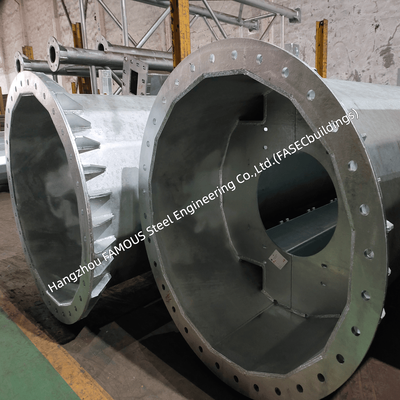
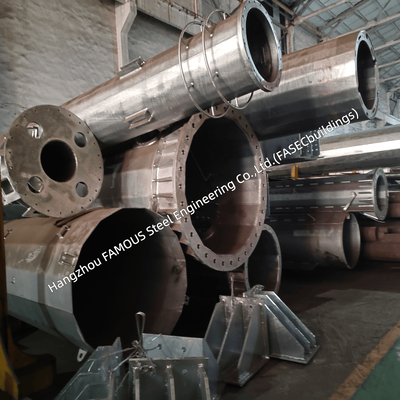
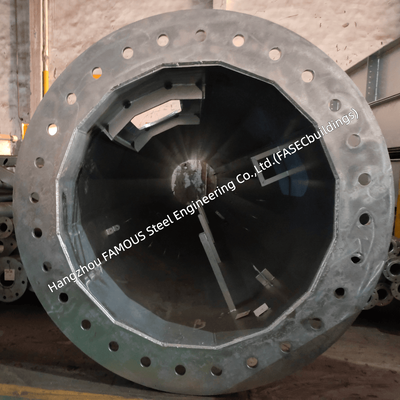
This octagonal tapered monopole is formed from steel plate into a polygonal conical section, seam-welded along its full length, and delivered in transportable segments joined on-site with bolted flange connections. Every pole is hot-dip galvanized (HDG) after fabrication, producing the uniform silver-grey zinc finish recognized worldwide on telecom monopole towers and galvanized utility poles.
Because the structure is engineered specifically for your project rather than a fixed catalogue size, height, plate thickness, section shape, and accessory layout can all be adapted to your specific load case, antenna configuration, and local wind code.

🌟 Why Choose an Octagonal Tapered Monopole?
-
Flat Mounting Surfaces: Octagonal faces provide flat surfaces, allowing antenna brackets, RRU mounts, and microwave dish adapters to sit flush without shimming.
-
Reduced Wind Load: The tapered conical profile keeps the top diameter small, reducing wind load and visual bulk in urban and suburban sites.
-
Superior Buckling Resistance: Polygonal sections resist local buckling better than thin round tubes under the same plate thickness.
-
No Field Welding: Factory-drilled and match-marked flange bolted joints mean site work is bolting only—no field welding and no hot work permit required.
-
Structural Integrity: Internal stiffener diaphragms at each flange transfer bolt loads into the pole wall and control ovalisation under high winds.
-
Clean Aesthetics: Pre-formed cable entry holes and internal cable routing keep feeders protected and the external appearance clean.
-
Total Protection: Hot-dip galvanizing to EN ISO 1461 or ASTM A123 provides predictable zinc coating inside and out, including inaccessible internal surfaces.
📊 Configuration Reference (Preliminary Sizing)
Note: Values below are typical reference ranges. Final dimensions are engineered against actual antenna loads, wind speeds, and governing design codes.
| Item | Typical Reference Range | Notes |
|---|---|---|
| Overall Height | 10 m to 60 m and above | Telecom sites commonly 15 m – 45 m |
| Cross Section | Octagonal, up to 16-sided; round and tapered round also available | Section count and shape follow the drawing |
| Steel Grade | Q235B, Q355B, S235JR, S355JR, Gr.50, A572 Gr.50 | Substitution subject to availability |
| Plate Thickness | 3 mm to 12 mm (thicker on request) | Governed by base moment and wind load |
| Joint Type | Bolted Flange (Standard), Slip joint (On request) | Flange thickness and bolt class per calculation |
| Galvanizing | 65 micron to 100 micron and above | EN ISO 1461 or ASTM A123, plus optional paint system |
| Design Wind | Set by project site | Can follow ASCE 7, AS/NZS 1170, EN 1991 or GB 50009 |
| Design Standard | Project specific | AISC 360, AS 4100, Eurocode 3 or GB 50017 |
| Welding | Submerged arc and CO2 welding | Procedure and welder qualification to AWS D1.1 or ISO 3834 on request |
| Accessories | As required | Platforms, ladders, cable trays, antenna brackets, aviation light, earthing terminals |
🏗️ Two Mainstream Applications
1. Telecom Monopole Tower
Used as a 5G or 4G antenna pole for macro sites, rooftop installations, small cell densification, and rural coverage. The single-pole footprint is small, which is crucial where land acquisition is difficult. The polygonal shaft carries multiple antenna sectors plus microwave transmission equipment on one structure. Where planning authorities require it, the same structure can be detailed as a camouflage monopole with cladding or a tree canopy.
2. Power Transmission & Distribution Monopole
Used as a steel pole for overhead lines in low and medium voltage ranges up to subtransmission levels (typically 10 kV to 220 kV). Compared to wood and concrete poles, a galvanized steel pole is dimensionally consistent, lighter to handle, free from rot and insect attack, and easier to maintain over a long service life. Single/double circuit arrangements, cross arms, insulators, and climbing steps are all integrated at the fabrication stage.
🛠️ Built to Your Drawing, Not a Stock Size
Every monopole we fabricate is a custom structure. The starting point is your drawing, antenna schedule, or line loading table—not a standard product list. If you have site data but no drawing, we work from height, wind speed, antenna count/weight, and the required design code to return a proposal with recommended dimensions for your review.
Our Fabrication & Support Services:
-
Fabrication from buyer drawings, or design support from site parameters.
-
Shop drawings and approval drawings issued before production.
-
Material certificates, galvanizing thickness report, and dimensional inspection report supplied with the shipment.
-
Third-party inspection (SGS, BV, or TUV) can be arranged on request.
-
Section lengths planned around container and trailer limits; flange faces protected and bolt sets packed separately.
-
Trial assembly of joints before shipment available for multi-section towers.
❓ Frequently Asked Questions (FAQ)
Q: Is a monopole better than a lattice tower?
A: For a single-operator site with a small antenna load and tight land, a monopole is usually simpler to permit and faster to install. Lattice towers remain more economical for very tall structures or heavy multi-operator loading. Both are available.
Q: Can one design serve both telecom and power use?
A: The fabrication process is the same, but the design basis differs. Telecom poles are governed by antenna load and wind-induced vibration; power poles by span, conductor tension, and clearance. Tell us the intended use and we will design accordingly.
Q: What about lead time?
A: Lead time depends on height, quantity, and whether approval drawings are required. Small orders typically move faster than multi-section engineered towers. Share the scope and a schedule will be confirmed.
Q: Can the pole match American or Australian standards?
A: Yes. Material, welding, and galvanizing can be aligned to AISC, AS/NZS, and EN requirements where specified in the enquiry.
📩 Get Your Tailored Proposal
To receive a tailored technical proposal and commercial offer, please share the following details:
-
Pole height
-
Intended use (Telecom or Power)
-
Antenna or conductor loading
-
Design wind speed
-
Governing design code
-
Quantity
Drawings in PDF, DWG, or DXF formats are all acceptable.
Recommended Products